

For the redesign and rebuild of the SoBold website, the content needed as much attention as the design: every page had to reflect what we offer and protect the organic rankings we’ve worked hard to grow. Utilising an AI workflow we’d already built let us hit our deadline without pulling time from client work.
A writing system that already knew our website
The starting point was a Claude project we think of as our SoBold “super agent”. We fed it all content from the old site along with our natural writing style, our expertise and the full picture of what we offer. From that, Claude built a master content inventory and a set of reference files (brand guidelines, tone of voice, writing-style rules) that describe how we write as humans and pinpoint exactly what we do as a business.
Sitting on top of that knowledge is an eight-agent writing pipeline we’ve covered in detail before. In short, separate agents handle:
- SEO data collection, using live SERP and keyword data through the SEMRush MCP
- Research
- SEO recommendations
- Drafting
- AEO pattern checks
- E-E-A-T scoring, against a seven-point scorecard
- Humanising and fact-checking
What follows is what happened when we pointed that pipeline at a full rebuild.
Service pages guided by transcripts
Rather than rewriting the service pages from the old copy, we started from conversations. Will, our founder, and Sam, our Managing Director, first reviewed the full service offering together, then sat down with the leads of each department to get a candid, current account of what we deliver and how. Laura, our Head of Design, walked through the design pages. Leo, our lead developer, covered development, with Sam adding the hands-on detail he still carries from his time as Technical Director. The same sessions ran for our SEO services, our AI services and the industry pages.
Recording and transcribing meetings to feed into shared folders is standard practice at SoBold, so every session produced a transcript: our services described directly by the people who deliver them. Those transcripts, along with the still-relevant sections of the old website copy, became the source material fed into the writing pipeline.
Keeping drafts inside the design
Content for a rebuild has to fit a design as well as read well. Laura had produced UX wireframes in Figma for each service page, setting out which content blocks each page would use and where. By connecting Claude to Figma through the MCP integration, we could sync the transcript content directly to those individual blocks, so drafts were written within each block’s character limits and styling constraints from the start.
Handing the process to the project team
Our SEO manager ran the first pages through the pipeline himself: feeding transcripts in, reviewing the output against the existing content, and giving every draft a manual edit and verification pass. He also carries a full roster of SEO clients, and the launch date was fixed. Rather than let the website content queue behind client work, we exported the whole process and handed it to Lucy, the project’s PM, and Fay, one of our developers.
We started the handover in a meeting room, walking through the process end to end and setting Lucy up on Claude Code. We then had Claude benchmark where the content work stood and package everything we would need into a single shareable folder. Four documents did most of the work:
- Start here: what’s in the package, what’s left to do, and the sign-off points, including final copy approval from Will.
- Workflow: the step-by-step production process, from transcript synthesis through per-page briefs, drafting, QA and the Figma block-mapping step.
- Page status: every page, what’s done, what’s left, and the URL slugs.
- Gated decisions: anything needing resolution before publishing, plus the fact-check watchlist.
Alongside these sat a knowledge folder, the brain of the project:
- The voice guide
- The banned AI patterns list
- Calibration rules extracted from previous edit rounds
- The project context document
- The agent definitions themselves
All flagged as mandatory reading for Claude before drafting anything. With that in place, Lucy and Fay’s own Claude Code sessions could pick up exactly where ours left off, with the same writing style and the same quality gates.
A workflow that learns from its edits
It’s essential that every draft still gets a manual review and edit before sign-off. We feed the before-and-after comparison back into Claude with an explanation of what changed and why, and each round tightens the calibration rules in the knowledge folder. Drafts land progressively closer to what we’d consider finished, and while manual review still happens on every page, each feedback round leaves less to do and becomes more efficient.
The workflow outlives the rebuild
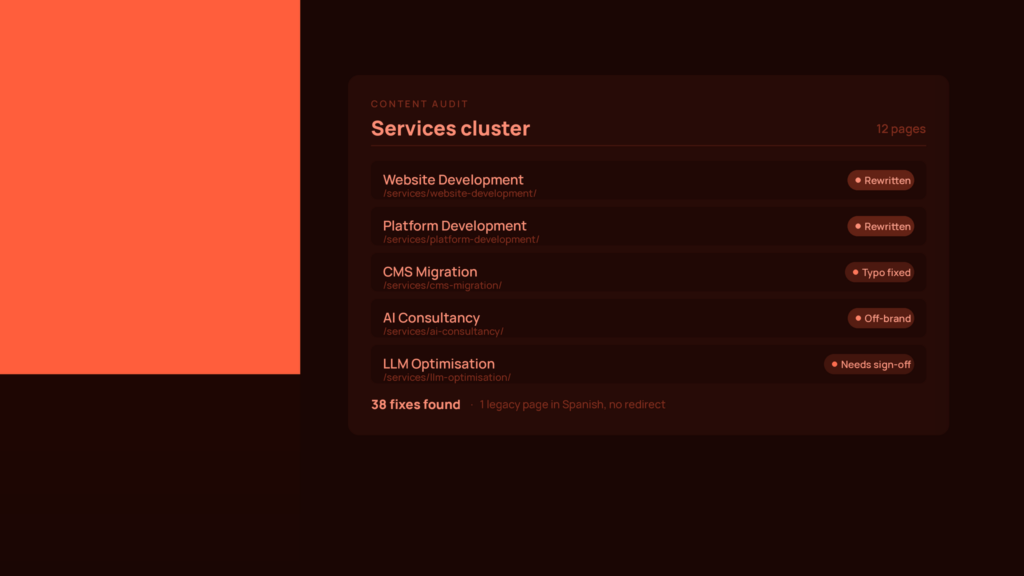
The system we built to write the site is the same one now maintaining it, so content reviews that used to wait for a clear week in the diary can run whenever a page requires updating, and the knowledge folder keeps the output consistent, whoever is at the keyboard. Manual reviews and rewrites are still mandatory, but the entire process becomes much more efficient and frees us up to spend more time on the important stuff: our clients.
If your own website’s content has been queued behind other priorities for longer than you’d like, our strategic SEO team works on exactly this kind of problem.