
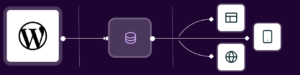
Headless WordPress experiences for a flexible tech stack

This website architecture allows larger teams to manage omnichannel content distribution, giving greater flexibility across platforms and devices.

A headless architecture means decoupling the front end and back end to allow for greater flexibility, scalability, and multi-platform content delivery.

This gives you the freedom to deliver content across multiple digital platforms, all while managing everything from your WordPress interface.
From a development perspective, it means you’re no longer tied to the Content Management System and instead you can use modern tools like JavaScript, React, Vue.js, or React Native to build fast and engaging experiences.

When to go headless

Multiple markets

Manage content centrally and distribute it across regional sites, apps, and microsites without duplicating infrastructure

Enterprise portals

High-performance portals and client-facing tools built in modern JS frameworks, content still managed by non-technical editors

Omnichannel

Push content to any channel without rebuilding the content pipeline for each one

Tech stack migration

Replace an ageing frontend or monolithic CMS while keeping editorial workflows stable during transition

Technologies we use when building Headless WordPress

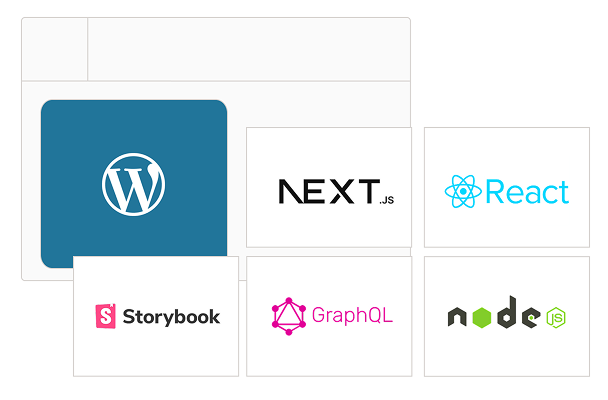
We build with modern frameworks like Next.js and Nuxt, connecting to WordPress via the REST API or GraphQL to deliver fast, flexible front ends.

Detaching the back end from the front end also means it can be isolated and restricted to specific IPs, reducing the attack surface your public-facing site presents in the first place.

Performance gains are usually significant, and biggest on large, high-traffic projects, but they depend on the connection between back end and front end being properly optimised, which is why we treat testing as part of the build rather than an afterthought.
Website & Platform Development services

We bring a deep understanding of diverse development challenges, from scaling complex web applications to integrating intricate API ecosystems.

Connect your systems, streamline workflows, and unlock new functionality with tailored API integrations.

View service

We regularly work with clients to help them migrate their website to an up-to-date content management system (CMS). Typically we perform migrations from Umbraco, Drupal, Contentful, and Sitecore.

View service

A thorough code audit is our first step when taking over the management of any website as it ensures we can effectively manage and develop on the website moving forward.

View service

Manage seamless multilingual experiences without compromising performance or consistency.

View service

Headless & REST API FAQs

Will Newland - SoBold founder

Get in touch with Will for more answers.

Headless WordPress separates the back end, where your team manages content, from the front end, which is built using modern tools like React or Vue.js to handle how it’s presented. WordPress stays the content source; the presentation layer is built independently.

Headless earns its keep on complex platforms where one content source needs to serve multiple mediums, such as a website and an app together. For most projects it’s not the right call: smaller builds are usually quicker to develop on more traditional infrastructure, particularly if you just want to manage your own data without an extra layer of complexity.

We build with modern frameworks such as Next.js, Nuxt, Vue.js and React Native, chosen based on your specific requirements, existing stack and goals.

Done well, headless architecture has no negative impact on SEO. We configure server-side rendering so crawlers can read your content the same way they would a traditional site.

Yes. Content is still managed through the familiar WordPress dashboard; it’s delivered to the front end via the REST API or GraphQL, so the editing experience doesn’t change.

Let’s scope your next project.

Whether you’re in financial services, healthcare, energy or another sector, we start every project with a conversation about your requirements. No commitment, just a discussion about your needs.

Schedule a consultation