

For B2B healthtech organisations, visibility inside large language models is quickly becoming a strategic priority.
Clinicians, hospital procurement teams, registry decision makers and health system leaders are increasingly starting their supplier research inside ChatGPT, Perplexity, Google AI Overviews and Gemini rather than a traditional search engine.
The sources these engines cite when answering specialist healthcare technology questions will shape which platforms make procurement shortlists for the next decade.
We work closely with leading B2B healthtech clients to define a practical set of content and structural interventions their internal teams could own.
Establish a measurement baseline
Benchmarking and understanding how you are performing in LLMs is an important starting point.
GA4 and Google Search Console should be able to show you if LLMs are already sending you traffic. You’ll be able to see which landing pages are pulling the LLM traffic, which should give you a starting point for knowing which content you are producing that is working and getting cited.
We’d recommend layering in monthly citation tracking across the major LLMs for a defined set of brand, product, and clinical query terms, alongside share of voice against your named competitor set.
Platforms like Profound and Searchable make this straightforward to run at scale, or the same tracking can be done manually in a spreadsheet by running a defined prompt list across the major LLMs each month.
Fresh content
LLMs prioritise sites that are actively producing content, and news, case studies, blog posts, interviews, events and webinars are all a content opportunity.
To address this, we’ve developed a structured content extraction framework built around recorded internal meetings, transcript processing and controlled LLM assistance.
It allows organisations to convert existing subject matter expertise into publishable content.
Internal account managers already have visibility of client relationships, industry shifts and market signals worth publishing about. The challenge is extracting that insight in a usable format without adding to their workload.
For example, if you wanted to create a case study, a quick win here is to arrange internal meetings with the account managers who work on that account, with note takers attached and recording these meetings. Prep the structure in advance and tell them what you’ll ask about, so background, approach, results and future development, and on the call be explicit as the host so the transcript captures the section changes clearly (“Right, now we’re moving on to the approach…”).
Take the transcript, feed it into an LLM with a very rigid set of instructions about how you want it to use this content and let it build out the content in the structure of what you’re needing to create. Once created, you can sense-check the output internally before publishing.
In a regulated environment, the transcript-to-draft output should always route through your existing content approval and clinical or compliance review workflow before publication.
This approach instantly gets you around the bottlenecks of extracting the content.
Structured question and answer content
Structured question and answer content is one of the highest-yield formats for LLM citation. The question and answer style in which people use LLMs matches the exact approach people take with FAQs, and they’re also brilliant at providing a level of subject depth that can then be picked up by the LLMs.
Making sure you have FAQs relevant to your different service and product pages provides specific question and answer content that LLMs can pull from.
Like the approach with transcription, you should be able to plug in to your customer support teams to get a clear log of the questions your audience actually asks. This can be used as content for the FAQ’s.
Content architecture and internal linking
Internal linking is key for directing both users and crawlers from informational style pages through to your service pages, before hopefully converting.
Typically people spend a lot of time creating case study content, but at the end of the page users are met with the website footer. By adding in relevant service or product page roll ups at the bottom of these pages, you’re keeping users on the journey you actually want them on, and it also helps LLMs understand the relationships between the content on your site.
Mapping your content model so informational content sits in a defined relationship with your commercial content (platform pages, specialty pages, integration pages) is what allows both users and LLMs to traverse your site in the way you intend.
Technical foundations
Once you’re able to get fresh new content on the site, it is also crucial to make sure the site is technically sound so that crawlers can interpret and understand the content within it.
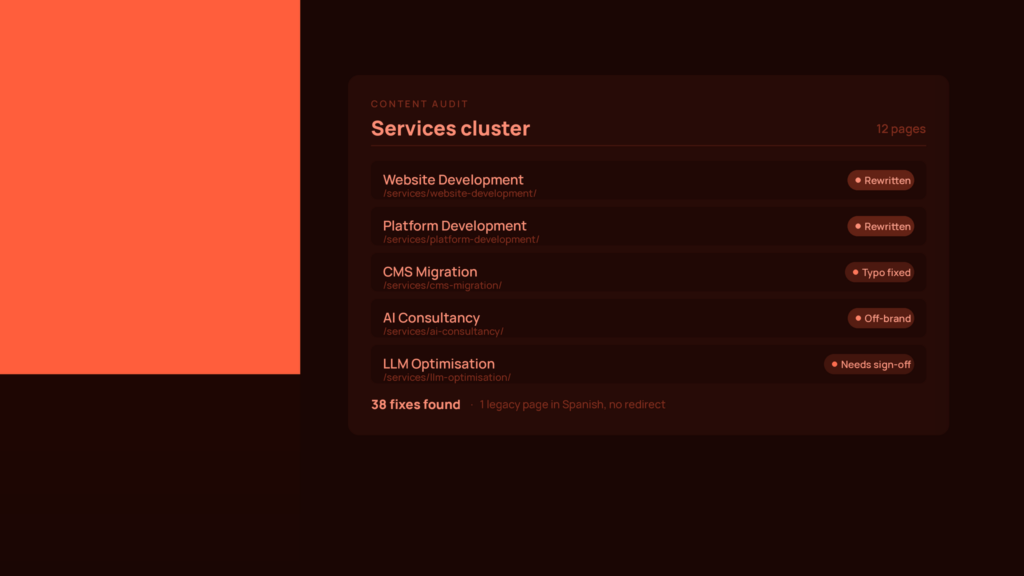
Schema, semantic markup, page structure, sitemap health and crawlability all matter, and working closely with your agency to get these areas right is really important.
For B2B healthtech specifically, this means implementing the appropriate schema types (SoftwareApplication, MedicalCondition, Organization, and Product where applicable), maintaining sitemap and robots.txt hygiene across any multi-market or multi-language deployments, and ensuring your content management system supports the semantic structure LLMs rely on to interpret authority.
Accessibility (WCAG 2.2 AA) and Core Web Vitals both feed into how AI crawlers evaluate content quality, and both are increasingly common items in NHS and enterprise procurement questionnaires.
Where a partner adds value
Most of what we’ve outlined here can be initiated by an internal team with the right operating model in place.
Where a specialist partner accelerates the outcome is in the initial framework design, the technical foundations audit, and the governance layer that keeps a growing content programme aligned with brand, clinical and regulatory standards over time.