
Earlier this month, our founder Will and Managing Director Sam Phillips sat down to talk through what we’re seeing at SoBold across client work at the moment.
One theme kept coming back: websites now need to serve two audiences, the people who visit them and the AI systems that read them, and each needs content presented in very different ways.
One website, two audiences
Designing a website now needs to cater for AI crawlers and answer engines alongside human visitors, and the two consume content differently.
A person wants a considered visual experience with “clear and intuitive signposting”. An AI system on the other hand, whether that’s Google’s AI Overviews or an assistant like ChatGPT or Perplexity, wants clean, structured, extractable information it can quote in an answer.
Designing for both at once requires a different mindset to the one most websites were built with.
Because it’s still early days, organisations are testing very different approaches. The Economist is publicly preparing for what its team calls a “two-track internet”, experimenting with agent-readable, Q&A-structured versions of its non-paywalled marketing and B2B pages alongside the human-facing site.
At the simpler end, some sites publish markdown versions of their pages to give AI systems a clean plain-text overview.
Google’s own guidance says none of this is needed for Google Search; the value of these experiments is in learning where agent traffic goes next before it starts to matter commercially.
The knock-on effect is that design and SEO are converging as disciplines.
Our designers and SEO team already work side by side on most projects, and it’s starting to reshape how we scope UX design work: the same page has to be designed for two audiences and optimised for two audiences at the same time.
Where design decisions used to be resolved between a designer and a brand team, there’s now a third voice in the room asking how the choice affects what a crawler can actually read.
Rankings up, clicks down
Across a good number of our client accounts, search rankings are improving while clicks from search are falling.
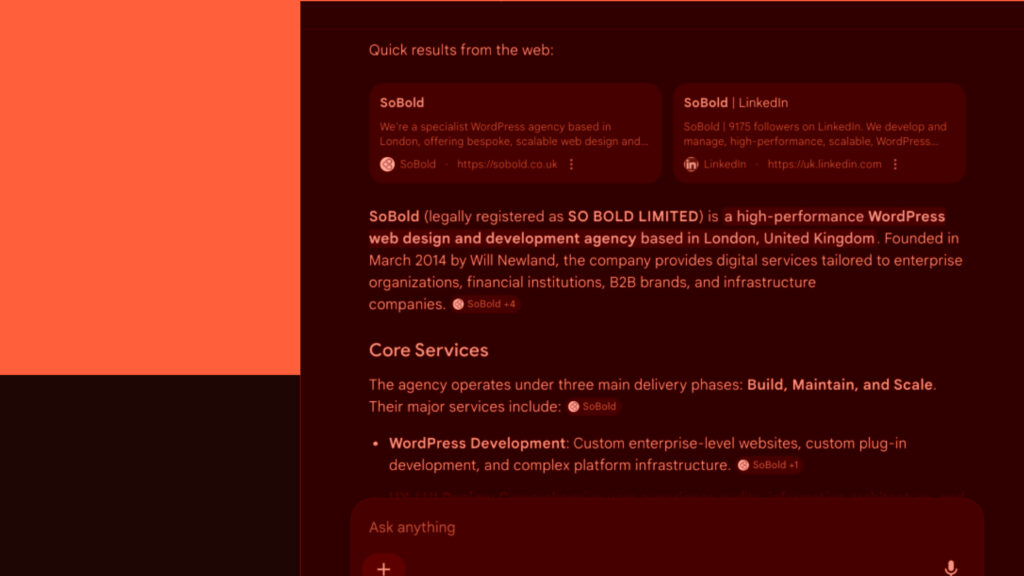
The cause is visible on the results page itself: AI Overviews answer the query before the visitor ever reaches a website.
The wider data backs up what we’re seeing in client analytics.
SparkToro’s June 2026 analysis of Similarweb clickstream data found 68% of US Google searches now end without a click, up from around 60% in 2024, and their UK follow-up found British searchers are the most zero-click of any country studied.
Ahrefs measured the same effect from the page side: clicks to top-ranking pages fell 58% on keywords where an AI Overview appears.
There are signs Google intends to keep traditional results in play.
At I/O in May, Google confirmed AI Mode is not becoming the default search experience; instead, its capabilities are being folded into the core search results over time.
SEOs including Lily Ray flagged the decision as significant, and we’d agree: a blended search-and-AI results page is a better outcome for everyone than a single closed answer engine mediating the whole web.
The practical shift for marketing teams is in reporting.
When rankings hold but sessions fall, the website isn’t underperforming; the results page has changed shape around it. Impressions, AI visibility and lead quality now say more about performance than raw session counts.
Structured data is still the quickest win
Structured data has become a standard part of how we prepare client sites for AI search: FAQs, people pages, portfolio pages and service pages in particular.
It’s one of the cheapest, fastest changes available, which is why it usually goes first on the list.
Trust is the harder battle
Information is now effectively free to produce, which makes trust the scarce commodity. Anyone can publish content that looks authoritative.
What’s hard is showing the knowledge behind it is real, and the sites that manage it convincingly, on the page and in the signals around it, are the ones AI search keeps citing.
A lot of our content work with clients now starts with transcription.
We interview the people inside the business who actually hold the expertise, then run the recorded conversation through a structured writing workflow.
The knowledge was always there; it just lived in people’s heads and never made it onto the website.
This article is itself a working example: it started life as a recorded conversation between two people who spend their weeks inside client accounts, and the observations in it exist because someone hit record.
What’s next from us
A few things we’re doing about all of this ourselves:
- A new website and brand, live in a matter of weeks. We’re in final development and QA now. The rebuild has doubled as a testing ground for internal workflow changes we’ve made over the past couple of months to speed up how we design and build.
- Agent-focused page experiments. We’ll be building pages designed for AI agents on our own site first and measuring how they perform, so the advice we give clients comes from our own results.
- A breakfast for marketing leaders on 6 August. We’re bringing together senior marketers to talk about how AI has already changed the discipline and what the next wave of change looks like.
The open question our team keeps circling is what design looks like in six and twelve months’ time, and how it coexists with AI search; nobody in the industry has a settled answer yet.
Where this leaves you
If your rankings are holding while clicks fall, or you’re being asked for an “AI strategy” and want to separate the real moves from the noise, our AI search and LLM optimisation team can benchmark where you stand and what’s worth doing first. And if you’d like to be part of the conversation in person, ask us about the August breakfast.