Designing your site for different audiences
Through our experience in working with Private Equity firms, their websites are typically focused on communicating with three distinct audience types:
- Founders and Management teams
- LP’s and Investors
- Perspective employees
Each audience type has a different goal when browsing the website, and ensuring the site doesn’t feel fragmented and rather feels like a single, coherent site where clear and intuitive signposting enables each audience to find what they need within the same structure is key to all successful website design projects.
Founders and management teams
Founders and management teams are assessing whether the firm would be a credible growth partner.
They want evidence of relevant experience, a clear investment thesis, and signals that this firm understands their sector.
Their site visits are often short and evaluative; they may compare multiple firms in a single sitting.
LPs and investors
LPs and investors need confidence in the strategy.
They want clarity on the investment approach, track record, and value creation methodology.
Their engagement tends to be more thorough, and they’ll typically browse through multiple pages, and want to get a clearer picture of your portfolio and who you work with.
Potential employees
Potential employees, even though typically of less importance than the other two audience types want to browse the site to get a feel of the firm itself to get a gauge of the company culture and ambition
Portfolio presentation and content density
Specifically across the Private Equity client projects we’ve delivered, the portfolio section is consistently the hardest to get right and typically each project comes with a different challenge.
Traditional approaches organise investments by sector, for example: technology, healthcare, and consumer.
Whilst this approach mirrors internal fund structures, it rarely reflects how the firm actually thinks about its investment thesis.
Firms with more thematic strategies, whether that’s digital ecosystems, sustainability transitions, or founder-led businesses, find that sector-based categorisation actively misrepresents their approach.
The density problem compounds this. Portfolio pages that list every current and realised investment with full descriptions become walls of content that no visitor reads thoroughly.
The instinct to include everything is understandable, but through our experience, it often buries the strongest examples under a mass of equal-weight entries.
Thorough research and collaboration between the agency partner and the client are key to ensuring that the right approach is reflected online.
Stakeholder dynamics
Stakeholder dynamics are always a going concern across corporate projects.
Partners often hold strong aesthetic opinions shaped by the websites they admire personally, which may or may not align with other partners’ preferences.
Compliance and IT teams review what can and cannot be said publicly about investments, performance, and strategy.
Marketing teams sit between these groups, working to manage the competing priorities while trying to keep the project moving.
Stakeholder involvement, as and when is required, is key to ensuring that voices are heard, but timings aren’t affected, and the process can continue moving forward.
What the process involves
The web design and development process typically works in a waterfall manner, where each phase is completed before moving onto the next.
Research and brand alignment comes first: enabling the agency to understand the audiences and competitive landscape in detail, then establishing the visual direction through moodboards and exploration.
This phase consistently takes longer than firms expect, but it prevents expensive rework downstream.
For firms that have recently rebranded, it also includes reconciling the new brand identity with what actually works in a digital context; brand agencies and web development agencies often have different perspectives on how visual elements should translate to screen, and resolving that tension early is critical.
From our experience, firms that invest in a thorough moodboarding and visual exploration phase at the start find that subsequent design approvals move significantly faster, because the subjective decisions about colour, typography, imagery direction, and layout principles have already been made.
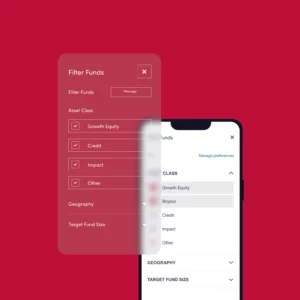
UX and information architecture follow, structuring the site around how audiences actually navigate.
Private Equity firms tend to organise their thinking by practice area or fund, and the information architecture needs to reflect this flow.
UI design brings the visual direction to life across responsive breakpoints, with accessibility compliance built in from the start rather than retrofitted before launch.
Development, typically the least collaborative phase, involves the agency development team building the site out on a development link, in order for the client to test the site, and get to grips with how to manage content uploads and changes. This ownership over management enables you to have the tools to scale your website internally and ensure the site does not sit still after launch.
Testing, content migration, and launch preparation round out the process, which includes redirect mapping, structured data, and technical SEO work to ensure nothing is lost in the transition.
The launch of your site should be relatively seamless with IT and your agency partner working together to ensure the site is live and functioning on its server set up.